
To see a log of current events and activities please visit the Daily Commentary Page or for older information please the Archive Page.
2024 – The Story
Background
A nesting box with platform was installed in Leicester Cathedral’s spire in March 2016. The following year, the resident pair attempted to breed on the platform, but unfortunately both clutches failed. In 2018, the same pair managed to rear two young to fledging, and in 2019 three young fledged successfully. The next two years both ended in breeding failure: the death of the resident female in a brutal battle led to the loss of four eggs in 2020, and the one egg laid by the new and inexperienced female in 2021, proved to be infertile.
The traumas continued and took another dramatic twist in 2022. We lost our veteran male at an age of 14 years due to injuries caused in a dogfight, whilst the female incubated four eggs. The victorious new male soon bonded with the female and after a reluctant start, incubated, fed and raised the two chicks to fledging as though they were his own. One of these juveniles left the territory very early in its development. Unfortunately, the female and the other juvenile succumbed to Avian Influenza (AI) which was prevalent throughout the country across multiple species during the year. In addition, another unknown female was found dead at Leicester University with the same disease.
The new resident male paired up with a new female at the end of August and their bond grew strong quickly. However, by late October it was apparent that the male looked moribund and on the 21st he fell from the platform, another victim of AI from the postmortem results.
During the final two months of 2022, the female visited the box most days for short periods, but she ended the year without a known partner. She picked up a new mate early in 2023 and the season had fewer of the traumas that often surround breeding at Leicester Cathedral. All three juveniles were nurtured to fledging and were seen flying freely. Unfortunately, one succumbed to a collision with a large glass window.
The 2024 Season
During the early weeks of January, the male visited the box most days, sometimes for extended periods and often overnight. The female’s visits were less frequent and brief, and she occasionally used the box to stash her meals. There were short bouts of bonding between the pair. As the month progressed daily visits and bonding sessions were more regular and the female started to tend to the scrape. The actions of the male suggested the presence of an intruder on a few days from the 21st and he spent more time on the platform and frequently slept on the ledge overnight.
February saw a continuation of the established routines, with both birds making regular, but brief visits to the box during the day, and the male frequently sleeping on the ledge overnight. From mid-month onwards, bouts of bonding became more frequent. The male brought in fresh prey for the female to help get her in full breeding condition and this behaviour became more pronounced as the month progressed. She remained overnight on the ledge for the first time on the 20th.
As expected, March brought a shift towards breeding behaviour. The female spent increasing time tending to the scrapes in the box, and there were more frequent bonding sessions. The visits to the box by the pair increased and, on the 13th, both birds remained on the ledge overnight and the female on the 16th. The first egg was laid the following day, the earliest date for this site, and three more were laid over the course of the next eight days: the 20th, 22nd and 25th. Both birds shared incubation duties. The male brought prey for the female, who sometimes left the box to feed, allowing the male to incubate, initially mostly for short periods and often watched by the female from the ledge. The pair’s cooperation was evident, with both birds taking turns incubating and there was a well-established routine.
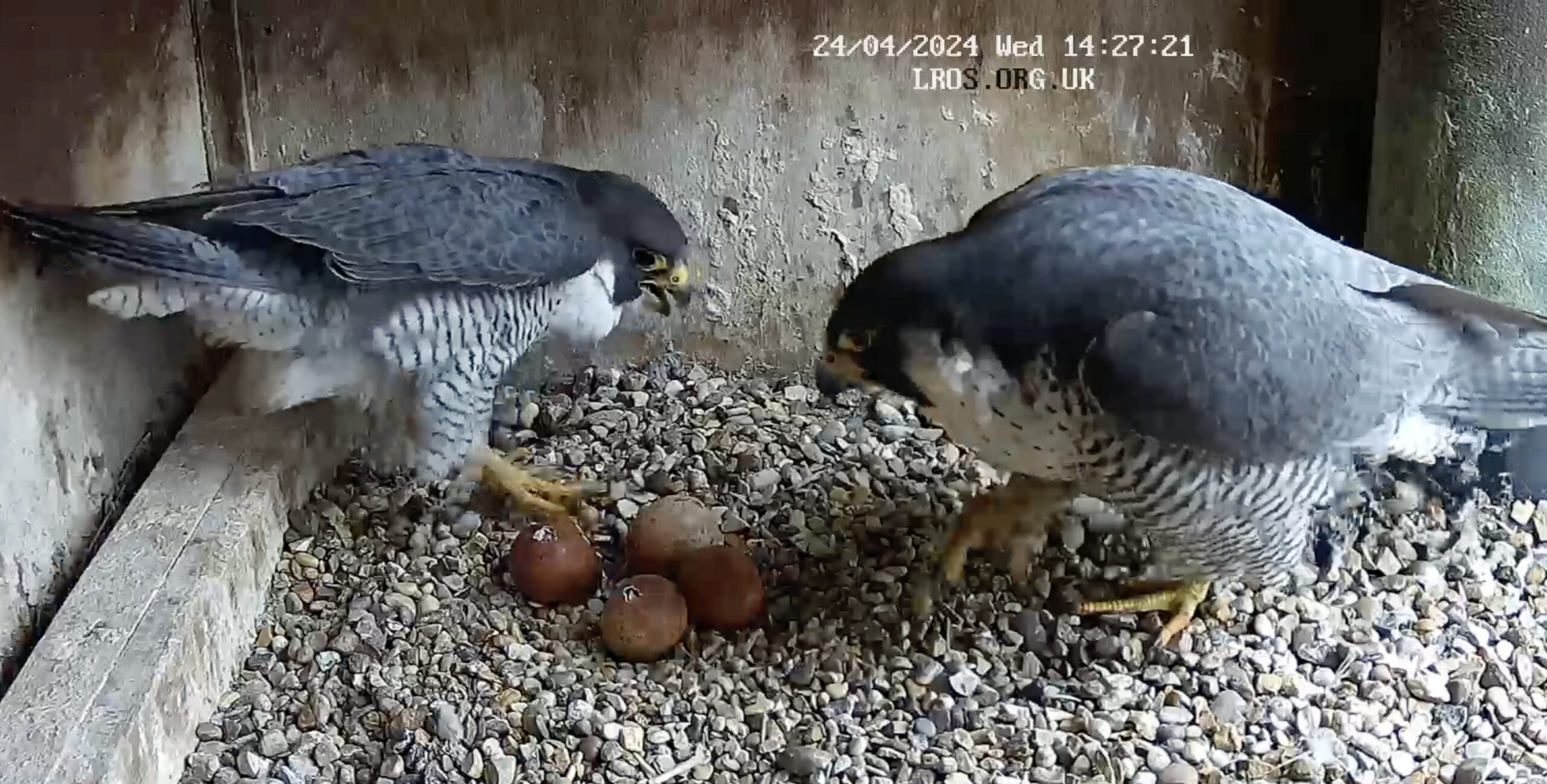
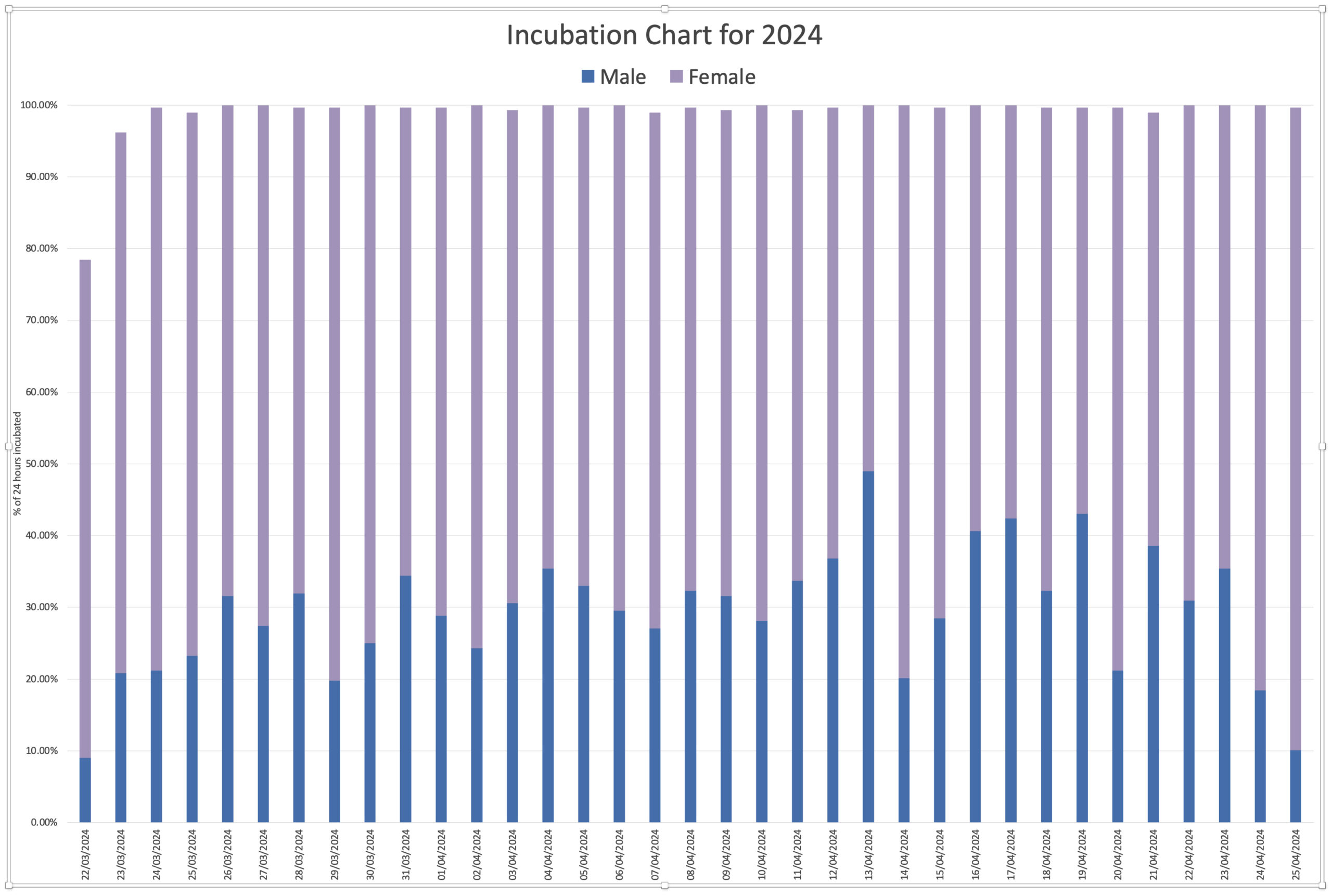
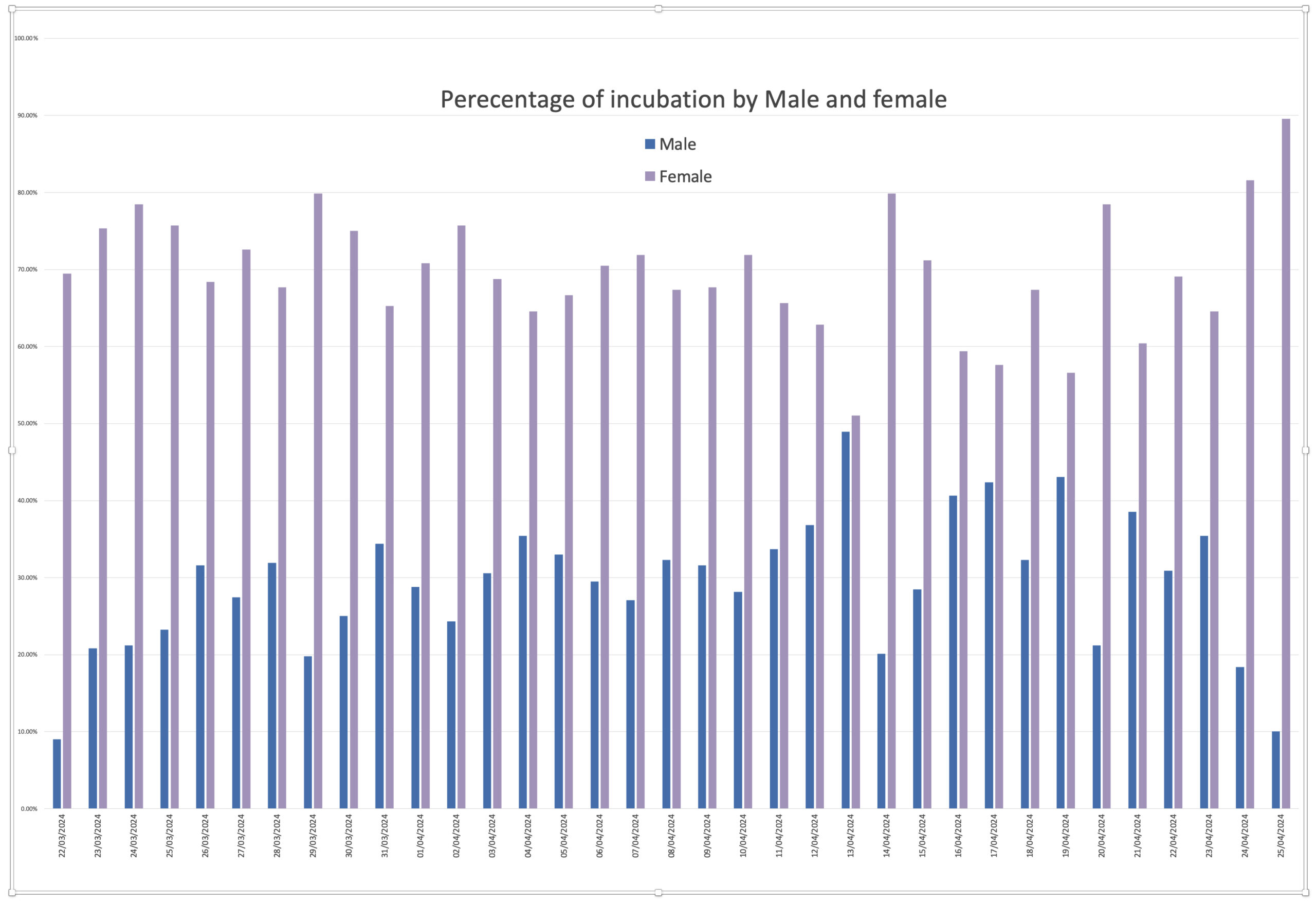
Most of April was uneventful and dominated by incubation with the anticipation of hatching. The female was the primary incubator, with the male providing her with food and taking over during her absences. From the first egg being laid until the first hatching was a period of 39 days. Full incubation usually starts with the third egg and from thereon, the eggs were incubated by the pair 99% of the time. As usual, the female took the largest share with 69.68% of the time on the eggs and all but three of the overnight sessions. The male would occasionally sleep on the ledge overnight. He completed a very respectable 29.32% of the time incubating. This showed the strength of bond and commitment of the pair. The first chick hatched in the early hours of the 25th and two others hatched later the same day. The female’s trust in the male was strong, and he was allowed to incubate the chicks from day one. The female started to feed them small meals regularly through the next day. The fourth chick hatched at 18:15 on the 27th, almost 48 hours after number three. Unfortunately, despite being just two days older, its siblings were much larger and stronger than the fourth chick and it would get hidden during feeding sessions and did not get its share of the meals resulting in its death the following day. Although the female could see no life in the chick, she continued to incubate it. An intruding male landed on the ledge late in the afternoon of the 29th. The female spread her wings to protect her offspring and she forced him out. Both the resident birds chased the intruder from the territory. The female continued to incubate the dead chick until the 30th when she disposed of it by consuming it over a period of an hour; this is not an unusual action.
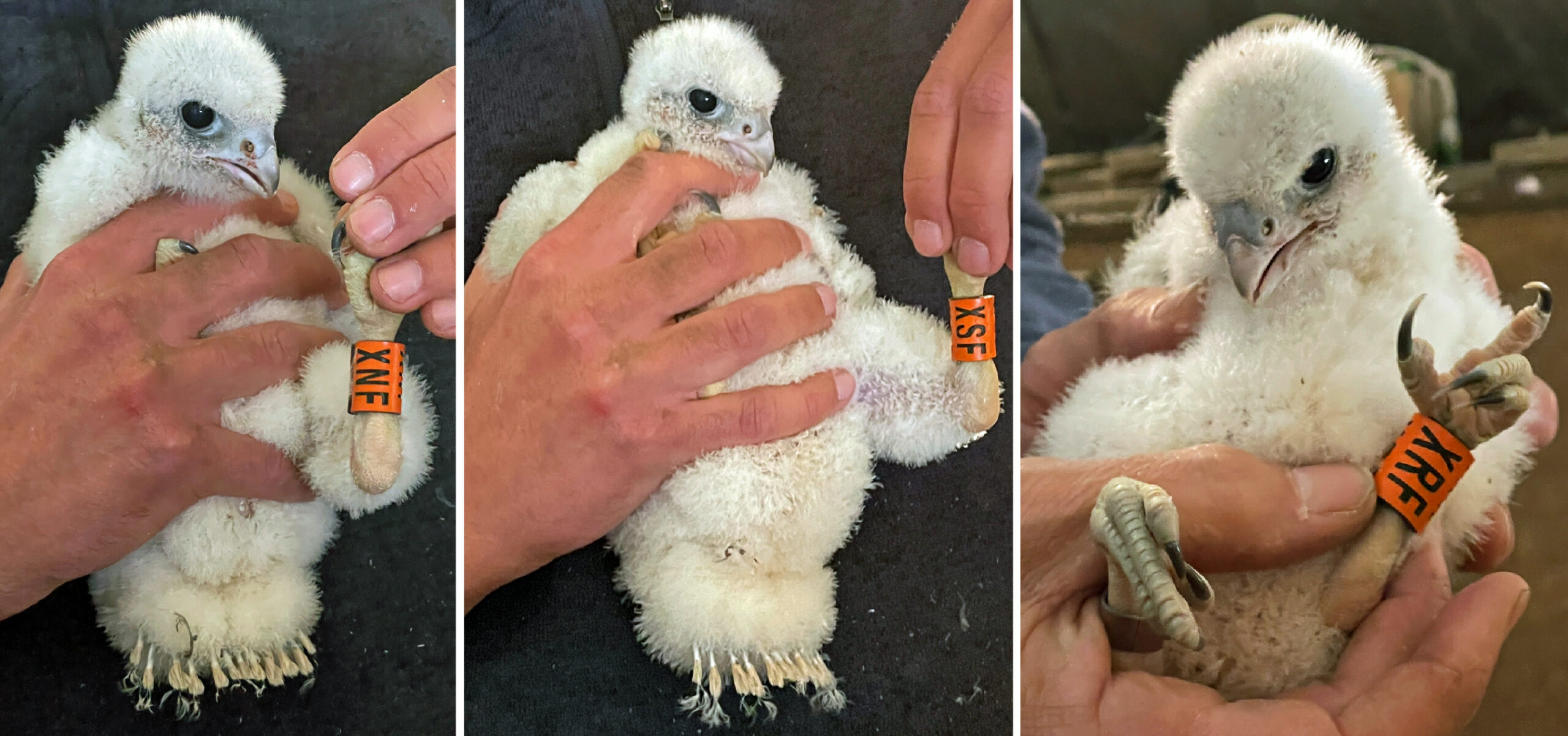
May was a period of intense parental activity. The female was the primary feeder, with the male supplying prey, mostly Feral Pigeon. The chicks grew rapidly, becoming more adventurous and mobile. Indeed, the first excursion from the scrape was at just seven-days old. Feeding sessions were frequent, mainly by the female, with both adults bringing in prey. The chicks continued to thrive, engaging in wing-flapping exercises and exploring the box and platform. The adults’ behaviour was focused on feeding and protecting the chicks, but by the 6th were too large to fully incubate. By the 11th, the chicks were becoming more adventurous and able to cope with the increasing ambient temperatures, huddling together, and were often left alone overnight. Two days later, they were large and strong enough to be colour-ringed under licence. They appeared to be two female [XNF and XSF] and one male [XRF]. The adult male arrived with food soon after we finished ringing and was joined by the female; they were none the wiser. By this time, the female occasionally allowed the male to feed the youngsters. The month ended with the chicks well-fed and increasingly independent, wandering the box and platform doing their exercises.

June marked the transition from nestlings to fledglings. The chicks became more active, practising wing-flapping and exploring the platform. The adults continued to provide food, but the juveniles began to feed themselves and engaged in tug-of-war over prey, strengthening their muscles. The juveniles took their first flights on the 8th – not necessarily by choice. The first to leave was XRF at 05:00. XRF and XNF were sitting on the ledge as XSF ran quickly into the box flapping vigorously. The two siblings were startled by this and XRF took flight as XNF stood behind the central column. XNF was the next to leave, again not by design. At 05:30, XSF was wing flapping and jumped into XNF and forced it from the ledge. XSF remained in the box feeding and doing wing flapping exercising until 10:30 when it made a rather more graceful departure that its two siblings; all three juveniles had fledged. XNF was the first to return to the box three days later, and all three were seen in the box and had fledged successfully. The adults’ role shifted to supporting the fledglings, who returned to the box and ledge for food and shelter, and occasionally remained in the box overnight. The juveniles’ independence grew, with longer absences and more self-feeding. The adults maintained their presence, occasionally feeding on stashed prey and tending to the scrape. The month ended with the juveniles fully fledged.
July was characterised by reduced activity as the juveniles dispersed. XSF was last seen on camera on June 29th whilst XNF and XRF remained in the area. They frequently returned to the box and would chase and harass the arriving adults to encourage them to bring in food. Feeding continued, but the frequency decreased as the juveniles became more independent. Indeed, there was no activity noted on camera for the first time on the 26th and just one short visit by XRF the following day.

The adults’ behaviour returned to pre-breeding patterns, with regular ledge occupation and occasional bonding sessions often disturbed by the arrival of the juveniles. The month was quieter, reflecting the independence and natural dispersal of the youngsters.

During August, the adults reasserted their territory, with regular bonding and scraping sessions in the box. The juveniles made occasional visits, sometimes carrying prey and engaging in feeding or tug-of-war with the adults. The male and female’s interactions were marked by brief bonding sessions and coordinated defence against intruders. Feeding continued, with both adults and juveniles stashing and retrieving prey. The adults’ behaviour was focused on defending the territory and maintaining their bond. The juveniles’ visits became less frequent as they establish their independence.
The male and female maintained and consolidated their routines during September, with regular ledge occupation of the box and bonding sessions. The juveniles’ visits were sporadic, often involving feeding on stashed prey or brief interactions with the adults. The adults’ behaviour was focused on territory maintenance, with frequent scraping and feeding. Intruder activity was minimal, and the pair’s interactions were calm and routine. The month reflected the stability of the territory and the successful dispersal of the young peregrines as XNF was last seen on September 4th, although XRF remained around the nest site.
The pattern of routine territory maintenance continued in October. The adults engaged in regular bonding and scraping sessions, with occasional feeding on stashed prey. XRF made brief appearances, sometimes engaging in tug-of-war over meals with the adults, forcing the juvenile to hunt for food. There was a certain amount of aggression by XRF towards its parents. On the 8th, XRF looked to be attempting to make a scrape in the stones. This was the first time I had seen a bird of this age undertake this activity, at less than six months old. Later he was seen to force the male from the box and push him off the platform. There was similar aggression on the 12th and 14th. On the 27th and 28th, XRF pursued the male around the box and forced him to leave but was tolerant and submissive to the female.
The overall pattern in November was one of stability and routine. Both adults and XRF were seen most days either feeding in the box, resting up or pair bonding. The juvenile continued to harass the male and had disputes over meals with the female. The adults maintained their routines, with regular ledge occupation, scraping and bonding sessions.
It was pretty much copy and paste for December with the adults maintaining their territory, regular box visits and bonding sessions. Surprisingly, XRF was still in the area and had not dispersed. This is unusual, although not unheard of, especially with juvenile males. On the 9th, he was seen to bring a Little Auk as an item of prey into the box. This species is a rare vagrant to the county with the most recent records being recorded in 2007 and 1997. Amazingly, there was another seen flying around Rutland Water on the morning of the 10th. There was very little of note during the rest of the month other than a traumatic end of the year. Just before midnight on New Year’s Eve, the adults were sitting on the ledge when fireworks started close by. This was not an official display and was extremely loud. The male left quickly, but the female cowered in the corner of the box for ten minutes obviously distressed. She flew out immediately they had stopped.
Summary
Other than the occasional intruder incursion, thankfully there was very little drama during this year’s breeding season. All four eggs hatched and three of the four chicks survived to fledging and this must be considered a great success. The fact that XRF remained in the territory is interesting, although not unheard of. Most juveniles disperse during August and September. XSF last being seen at the end of June is on the early side of being able to feed and fend for itself, whilst XNF remaining until the first week of September is more typical. Males are more likely to remain closer to their natal site than females but usually abandon their parents’ breeding territory during their first year.
The activities captured on camera really do give us an amazing insight into the lives of these special birds and an understanding of the difficulties and challenges that they endure that are normally out of view. It is only through the monitoring of sites like ours that show how precarious the life of a Peregrine family is.
The identification of individuals through colour ringing and the data collected, help us to improve our knowledge and conservation of this enigmatic species. As an educational tool, projects like this are easily accessible and bring wildlife and nature closer to the wider public, which hopefully encourages further engagement with the natural environment.
Prey Details
Of the 320 items of prey brought into the box, we were able to identify 308 of 20 species (just 14 species in 2023). Of these, there were 225 Feral Pigeon (104 in 2023) which accounted for over 73% of all identified prey (72% in 2023).
Other species identified: Black-headed Gull (1), Black-tailed Godwit (1), Blackbird (6), Canary (1), Coal Tit (4), Dunlin (1), Golden Plover (3), Great Spotted Woodpecker (2), Great Tit (1), Little Auk (1), Meadow Pipit (1), Moorhen (6), Redshank (1), Redwing (4), Robin (1), Starling (19), Stock Dove (3), Teal (4) and Woodcock (11).
The identification of the Little Auk in December was very much a surprise. This individual was most probably blown off course and very weak which enabled juvenile XRF to catch it. The Canary shows how opportunistic Peregrines are in selecting prey. Of the 11 Woodcock, all bar one were caught during the second winter period, with seven taken between November 22nd and 29th.
Jim Graham
Acknowledgements
My thanks go to everyone at Leicester Cathedral, King Richard III Visitor Centre and Leicester City Council. Special thanks to Ed Drewitt for his expertise in helping to identify some of the more problematic prey species. Thank you to Garry and Candice Barker for their ringing expertise. A very warm mark of appreciation to all the volunteers who help at the Watch Days, engage with the general public and promote the conservation of Peregrines.
To see previous year’s story, click on the link below.